


Inside OLIX: The Startup Building the Next Generation of AI Compute
Why AI’s Compute Bottleneck Is Becoming Impossible to Ignore?
Artificial intelligence has entered an era where performance is increasingly determined by compute rather than algorithms alone. Modern large language models and reasoning systems process enormous numbers of tokens while performing complex calculations that demand vast amounts of computing power. As models become more capable, every improvement often requires exponentially greater computational resources, creating enormous pressure on data centers, semiconductor manufacturers, and cloud infrastructure providers.
Much of today’s AI infrastructure is built around highly capable general-purpose GPUs. These processors have played a critical role in the rapid progress of generative AI because they can efficiently execute a wide range of machine learning workloads. However, generating AI responses is not a single computational operation. Producing each token involves multiple stages, each placing different demands on hardware resources such as memory bandwidth, compute units, and data movement. Running every stage on the same processor introduces inefficiencies that become increasingly significant as AI workloads continue to scale. The result is higher energy consumption, increased latency, and rising infrastructure costs that threaten to slow the pace of AI innovation.
OLIX Is Taking a Different Path to AI Infrastructure
London-based OLIX believes the future of AI compute requires rethinking the architecture of the modern data center rather than simply building larger and more powerful chips. Instead of treating token generation as a monolithic process executed entirely on one general-purpose processor, the company envisions AI inference as a production pipeline in which different computational stages are handled by specialized hardware designed for specific tasks.
OLIX compares this approach to the evolution of industrial manufacturing. Modern factories achieve efficiency by dividing production into specialized stages connected through fast, optimized workflows rather than asking a single machine to perform every operation. Applying the same principle to AI infrastructure, OLIX is developing what it describes as a “token factory” for frontier AI, enabling different hardware components to process different stages of token generation while minimizing the cost of moving data between them.
This architecture aims to address several of the industry’s biggest challenges simultaneously. By reducing bottlenecks in token generation, the company seeks to increase throughput while maintaining low latency, making AI systems more interactive without dramatically increasing infrastructure costs. Greater efficiency could also reduce energy consumption, an increasingly important consideration as hyperscale data centers consume growing amounts of electricity to support advanced AI models. Rather than competing directly with existing GPU manufacturers on raw processing power, OLIX is attempting to redesign how AI workloads are organized and executed across an entire computing system.
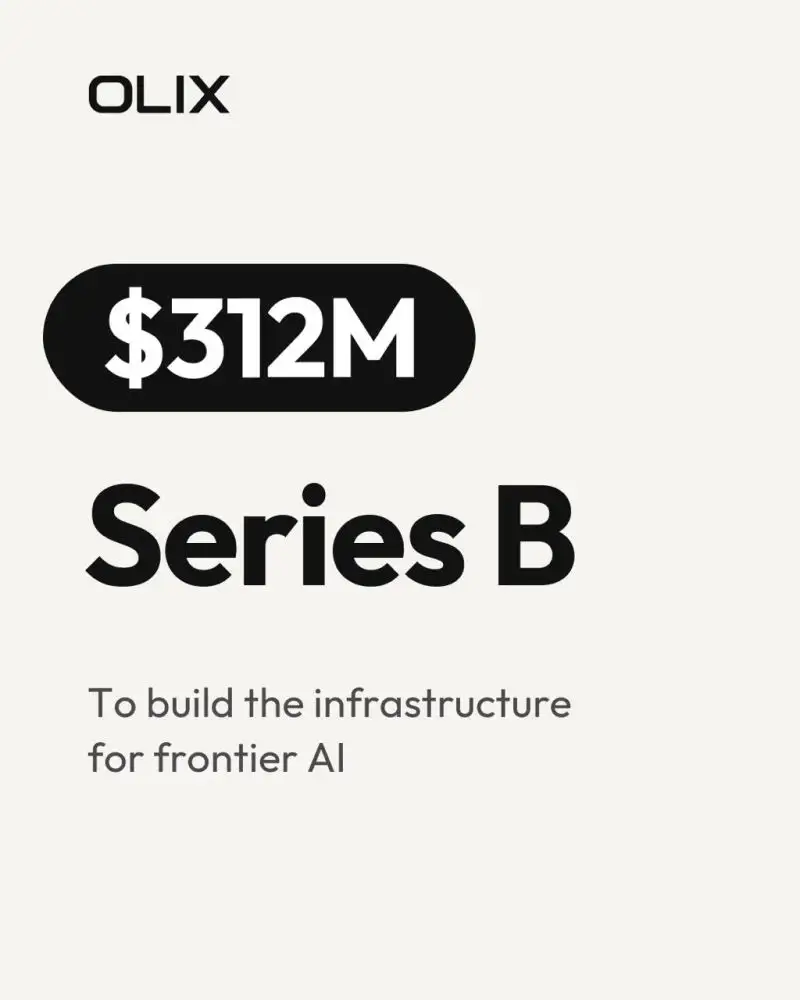
OLIX’s $312 Million Series B Signals Growing Confidence in AI Hardware
OLIX’s vision has attracted significant investor support. The company recently secured $312 million in Series B funding, providing substantial capital to accelerate research, engineering, and commercialization of its next-generation AI computing platform.
The investment reflects a broader shift occurring across the AI industry. While software models continue to advance rapidly, many experts now believe that future breakthroughs will depend equally on innovations in hardware architecture and systems engineering. The limitations of today’s compute infrastructure have created opportunities for startups developing specialized processors, advanced memory technologies, optical interconnects, energy-efficient accelerators, and entirely new approaches to AI data center design.
For OLIX, the Series B funding represents more than financial backing. It signals growing confidence that scaling artificial intelligence may require fundamental architectural changes rather than incremental improvements to existing hardware. As AI models continue to demand more computation, lower latency, and greater efficiency, companies capable of reimagining the infrastructure beneath modern AI could play an increasingly important role in determining how quickly the next generation of intelligent systems can be deployed. If OLIX succeeds in building its vision of a “token factory,” it may help redefine not only how AI models are executed but also how future AI data centers are designed from the ground up.
As reasoning models consume ever more compute, simply scaling existing GPU architectures may become increasingly expensive and energy intensive. OLIX represents a new generation of infrastructure startups questioning these assumptions by redesigning the AI data center around the flow of token generation itself. Whether this architectural approach becomes a new industry standard remains to be seen, but it highlights an important shift: the next major advances in AI may come as much from hardware innovation as from breakthroughs in machine learning.