

RevEng.AI: AI-Powered Binary Analysis for Reverse Engineering and Malware Analysis
Meet RevEng.AI, the Startup Bringing AI to Binary Reverse Engineering
RevEng.AI is building an AI-powered binary analysis platform designed to help security researchers, reverse engineers, malware analysts, and software security teams understand machine code more efficiently. While artificial intelligence has transformed many areas of software development, binary analysis remains one of cybersecurity’s most technically demanding disciplines. Security professionals often spend significant amounts of time manually examining compiled binaries to understand software behavior, investigate malware, identify vulnerabilities, or verify software integrity. RevEng.AI’s core mission is to apply advanced deep learning models directly to binary machine code, enabling computers to understand software at a much deeper level than traditional analysis tools.
The company focuses on both the semantic and syntactic understanding of binaries, allowing its AI systems to interpret how software behaves rather than simply recognizing patterns or signatures. This capability positions RevEng.AI at the intersection of artificial intelligence, reverse engineering, software supply-chain security, and threat intelligence, all areas becoming increasingly important as software ecosystems grow larger and more complex.
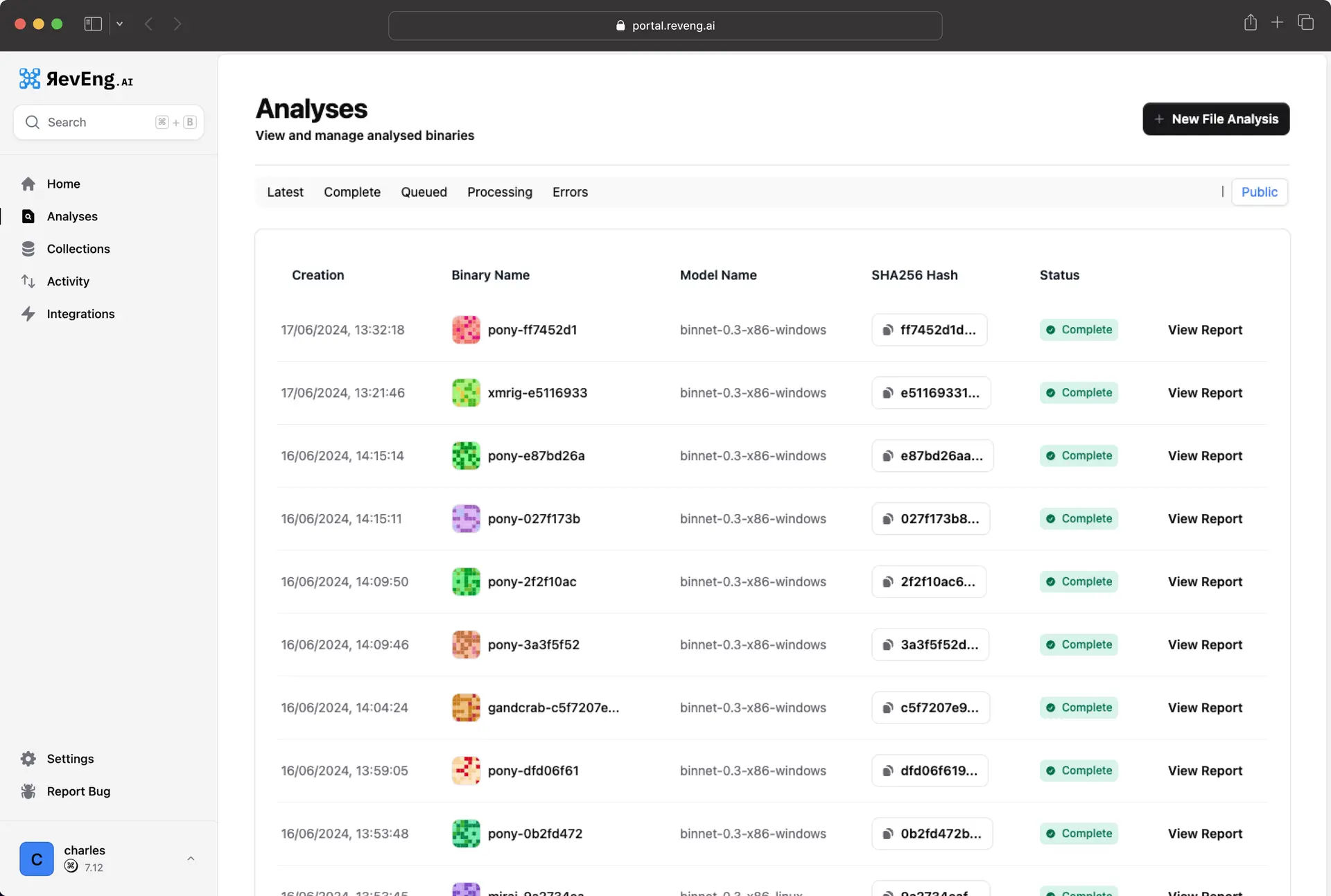
The Technology Behind RevEng.AI’s Binary Intelligence Platform
At the center of RevEng.AI’s platform are foundational AI models trained specifically on binary machine code. Unlike conventional cybersecurity tools that often depend on predefined rules, signatures, or manually created detection logic, RevEng.AI is developing models capable of understanding relationships and structures embedded within compiled software itself. This is significant because binaries represent the final form of software that runs on devices, servers, industrial systems, and critical infrastructure. Security teams frequently need to analyze binaries without access to source code, making reverse engineering a critical capability for vulnerability research, malware investigation, and software verification.
The company’s AI models are designed to automate parts of the reverse engineering process that traditionally require highly specialized expertise and substantial manual effort. By accelerating binary comprehension, the platform can potentially help analysts identify software functionality, uncover hidden relationships within codebases, and understand malicious software behavior more quickly. RevEng.AI also places significant emphasis on software supply-chain security. As organizations increasingly rely on third-party software components, open-source libraries, and externally developed code, verifying software integrity at the binary level becomes increasingly important. The company’s technology aims to provide visibility into software artifacts even when source code access is unavailable, helping organizations assess trust and security risks more effectively.

From Malware Detection to Threat Hunting: Where RevEng.AI Fits In
The practical applications of binary intelligence extend across multiple cybersecurity disciplines. Malware analysts can use binary analysis to understand how malicious software operates, what capabilities it contains, and how it interacts with targeted systems. Threat intelligence teams can leverage these insights to identify emerging attack techniques and improve defensive strategies. Vulnerability researchers represent another important user group. Modern software environments contain millions of lines of code spread across countless applications and dependencies. Understanding software behavior at the binary level can help researchers identify weaknesses that may not be immediately visible through traditional analysis methods.
RevEng.AI’s technology also aligns with growing interest in proactive software assurance. Organizations increasingly want to validate software integrity before deployment rather than relying solely on post-incident detection. This becomes particularly relevant in industries where software trustworthiness directly affects national security, critical infrastructure, defense systems, healthcare environments, and industrial operations. The company’s focus on AI-powered analysis reflects a broader cybersecurity trend where machine learning is being applied not only to threat detection but also to deeper software understanding. As software ecosystems become more interconnected and attack surfaces expand, automated binary intelligence may become an increasingly important layer within modern security operations.

RevEng.AI Raises $15 Million Led by NATO Innovation Fund
In May 2026, RevEng.AI announced a $15 million Series A funding round led by NATO Innovation Fund, with participation from In-Q-Tel and Sands Capital. The investment highlights growing interest from both commercial and strategic investors in technologies focused on software security, AI-powered cybersecurity, and supply-chain assurance.
The involvement of organizations such as NATO Innovation Fund and In-Q-Tel is particularly notable because software supply-chain security has become a strategic concern for governments, defense agencies, and critical infrastructure operators worldwide. Modern digital systems increasingly depend on software components sourced from diverse ecosystems, creating challenges around trust, transparency, and verification. The funding will support continued development of RevEng.AI’s foundational models, platform capabilities, and broader commercialization efforts. It also reflects confidence in the company’s vision that binary-level AI analysis could become a foundational technology for future cybersecurity workflows.
As software systems continue growing in complexity and scale, organizations need more sophisticated ways to understand what their software is actually doing. RevEng.AI is betting that AI-driven binary intelligence will become an essential capability for cybersecurity professionals tasked with protecting increasingly interconnected digital environments. RevEng.AI is targeting one of cybersecurity’s most technically challenging areas by applying AI directly to binary machine code. If its technology can reliably accelerate reverse engineering and software analysis workflows, it could become an important tool for software security, malware research, and supply-chain assurance in an increasingly software-dependent world.