

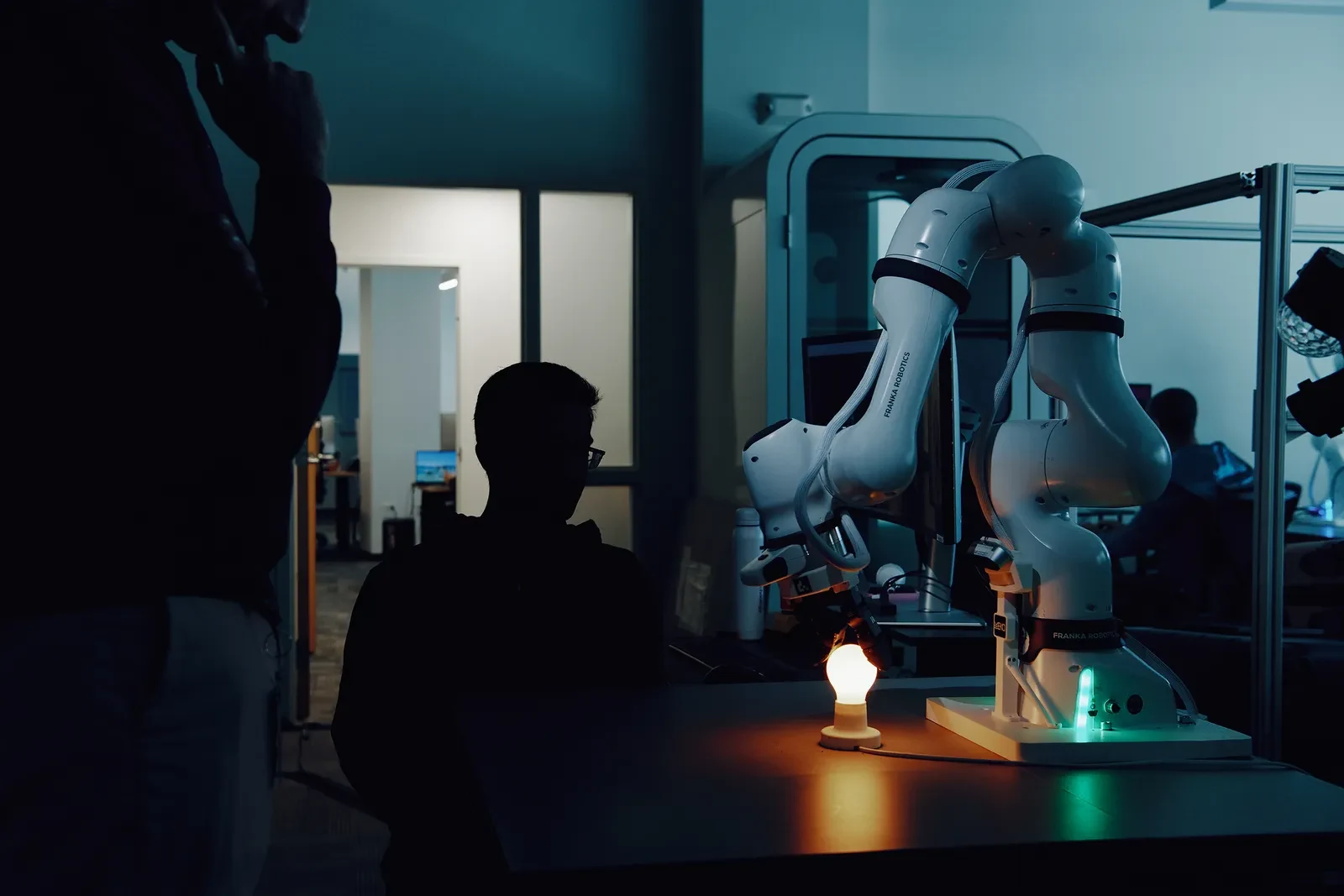
Eka Robotics is Building AI-Powered Robots for Complex Physical Tasks
How US-Eka Robotics Is Using Vision-Force-Action Technology to Advance Robotic Manipulation?
Robotics has made considerable progress in industrial automation, but enabling machines to perform tasks that require human-like dexterity remains a major technical challenge. Robots can execute repetitive movements with speed and precision in controlled environments. However, handling delicate objects, inserting wires, adjusting grip pressure and responding to unexpected physical contact require a different level of capability. US-based startup Eka Robotics is working to address this challenge through a robotics architecture that combines visual perception with force sensing and reinforcement learning.
Headquartered in Cambridge, Massachusetts, Eka Robotics is developing general-purpose robotic systems designed to perform complex physical tasks. Its central technology is called Vision-Force-Action (VFA), a model that combines information from cameras and force sensors to help robots understand and respond to physical interactions. The company is focused on dexterous manipulation, an area of robotics concerned with handling objects and performing tasks that require precise control of movement, grip and applied force.

The company’s approach addresses a limitation in conventional robotic systems. Camera-based robots can identify objects, estimate their positions and plan movements, but visual information alone cannot fully explain what happens when a robot makes physical contact with an object. A robot picking up a fragile strawberry, for example, needs to apply enough pressure to hold it securely without crushing it. Similarly, inserting a wire into a connector requires the robot to recognise resistance and adjust its movement accordingly. These situations require continuous feedback from physical interactions.
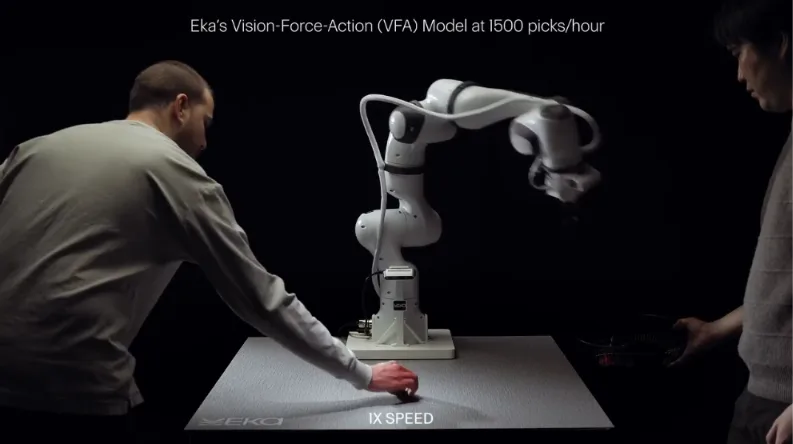
Eka’s Vision-Force-Action model brings these capabilities together. Vision provides information about the objects and their surroundings, while force feedback helps the robot understand what is happening during physical contact. The action component uses this information to guide movement and adjust behaviour. This allows a robotic system to respond to changes in grip, resistance and object movement while performing a task.
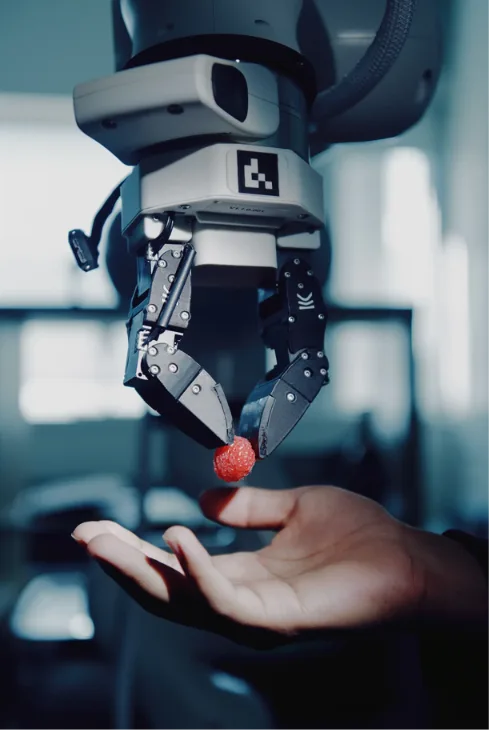
The company is also developing its robotic hardware alongside its AI model. Its approach involves custom robotic grippers equipped with force-sensing capabilities. These sensors provide information about contact and pressure, allowing the system to make adjustments during manipulation. The combination of hardware, sensing and software is central to Eka’s effort to improve the reliability and adaptability of robotic operations.
One of the company’s primary areas of focus is training robots to acquire physical skills through reinforcement learning. Traditional robotics systems often rely on human demonstrations or task-specific programming. While these approaches can produce effective results, collecting demonstrations for numerous objects, environments and possible situations requires considerable time and effort. Eka is pursuing an alternative approach that allows robots to learn through repeated experimentation in simulated environments.
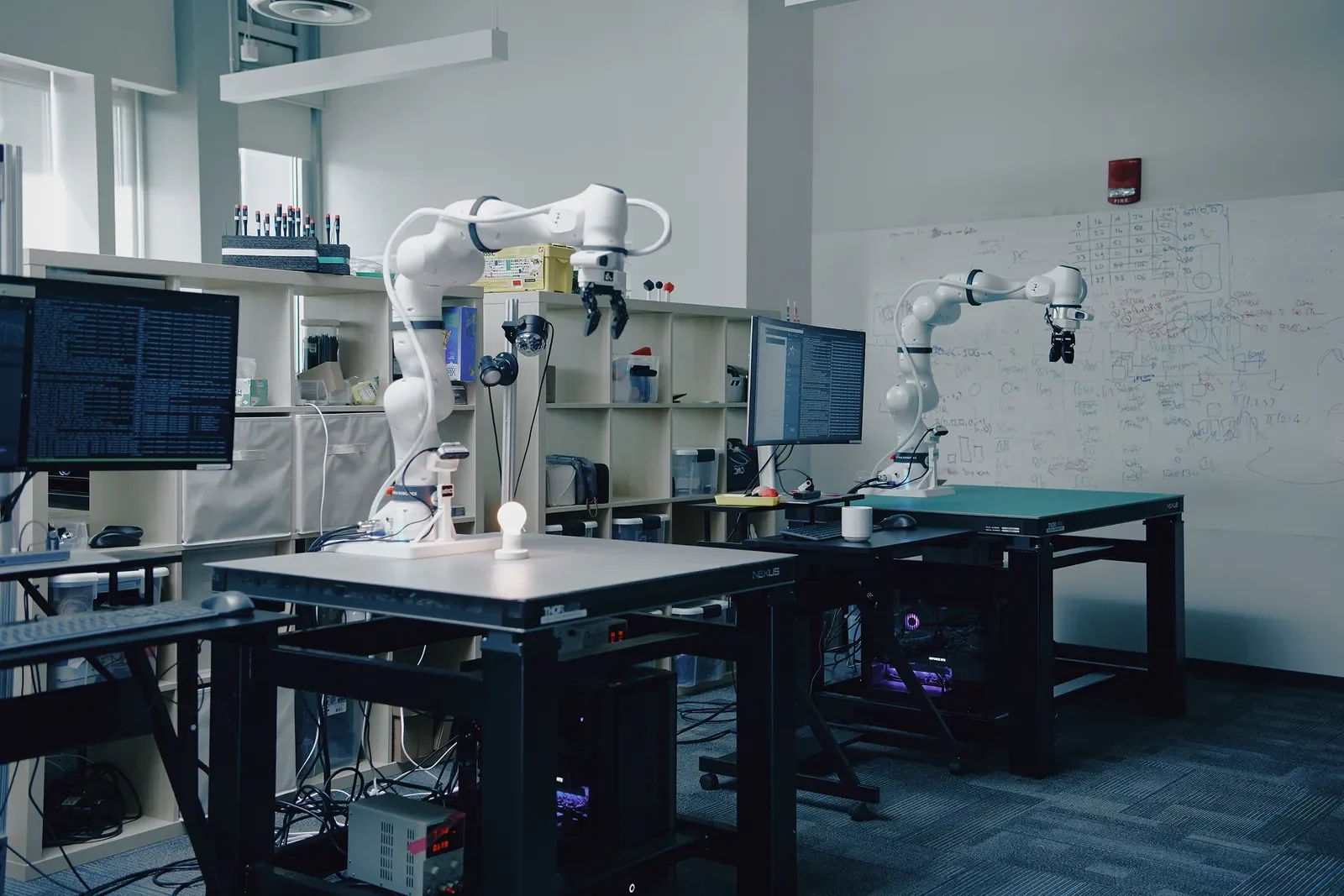
Using physics-based simulation, the company can generate large volumes of robotic experience under different conditions. Objects, environments, friction and contact conditions can be varied during training, allowing robots to encounter situations that may be difficult to reproduce consistently in physical experiments. Reinforcement learning enables the system to improve its behaviour through the outcomes of its actions.
Simulation also offers a way to generate training experience at a much greater scale than relying exclusively on physical robots. Eka says it can generate thousands of hours of robotic experience in minutes. The resulting learning is then transferred to physical robotic systems. This process, commonly known as sim-to-real transfer, has historically been a difficult problem in robotics because simulated physical interactions do not always match real-world conditions. Eka’s VFA approach is designed to address this challenge, particularly in tasks involving contact, pressure and object manipulation.

The company’s demonstrations provide an indication of the capabilities it is pursuing. According to Eka, its robots can perform approximately 1,500 picking operations per hour, compared with a human baseline of around 600 operations per hour. The company also reports that its systems can handle objects outside their training distribution. Its demonstrations include picking up delicate objects, screwing in a light bulb and inserting wires. These examples illustrate the company’s focus on developing robotic systems that can handle different physical tasks rather than relying exclusively on fixed movements.
Eka’s technology has potential applications across several industries. Manufacturing is one area where precise manipulation is important, particularly in assembly operations involving wires, connectors and small components. Food processing is another relevant application, where robots may need to handle fragile products such as strawberries without damaging them. Warehousing and logistics also involve picking, sorting and handling objects with different shapes, sizes and physical properties. These are among the types of tasks that require robots to respond to variations in their surroundings and the objects they handle.
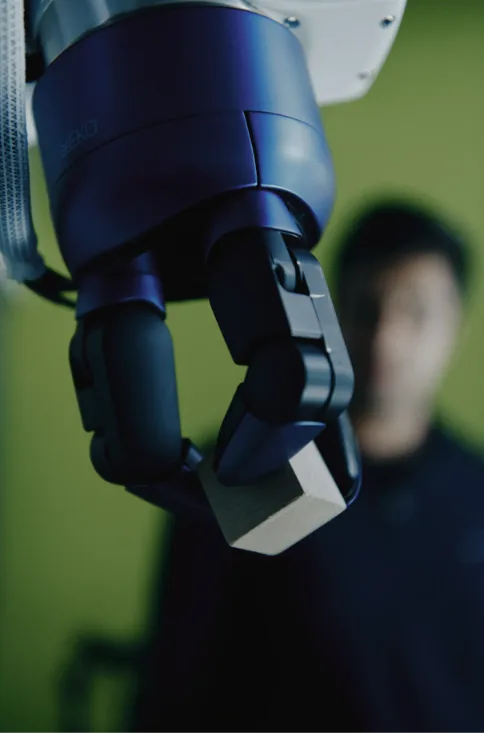
The company was founded by Pulkit Agrawal and Tuomas Haarnoja, two researchers with backgrounds in robotics and reinforcement learning. Agrawal is an MIT professor and leads research in robot learning through the Improbable AI Lab at MIT. His work includes reinforcement learning, robotic manipulation and transferring learned behaviours from simulation to physical systems. Haarnoja previously worked at Google DeepMind and is known for his contributions to reinforcement learning, including the development of the Soft Actor-Critic algorithm during his research career at the University of California, Berkeley.
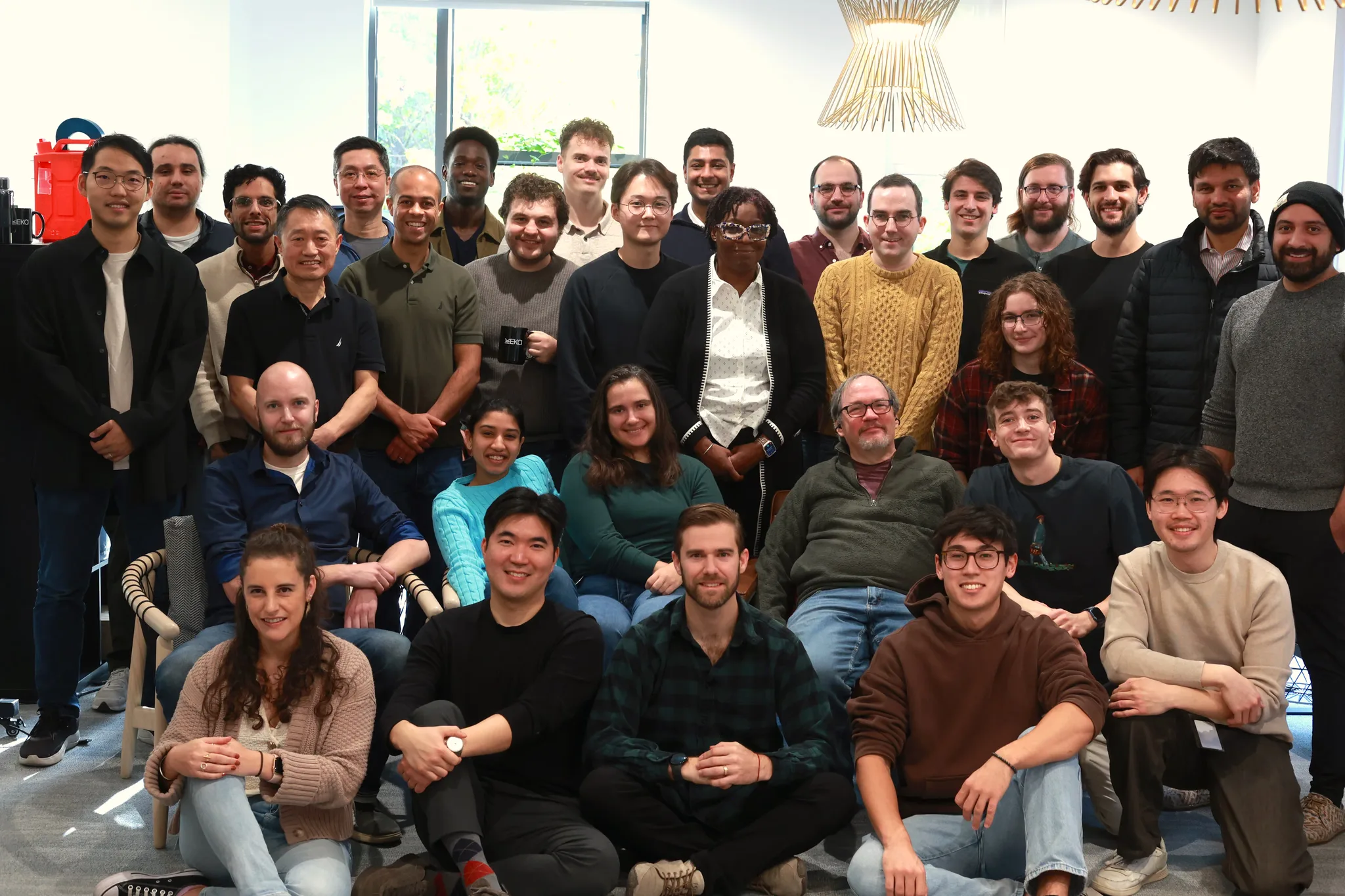
The broader team brings experience from research institutions and technology companies, including MIT, the University of California, Berkeley, Harvard, Carnegie Mellon University, DeepMind, Microsoft and Boston Dynamics. This combination of academic research and robotics engineering forms part of the company’s foundation as it works on developing and deploying its technology.
Eka Robotics attracted significant investor interest in October 2026, when it announced a $150 million Series A funding round. The round was led by Andreessen Horowitz (a16z) and F-Prime, a venture capital fund affiliated with FMR LLC, the parent company of Fidelity Investments. Existing seed investors Obvious Ventures and E14 Fund also participated. Other investors included MFV Partners, Bison Ventures, Glasswing Ventures, Samsung Next and several corporate strategic investors.
The company plans to use the new capital to scale its Vision-Force-Action model, expand the range of tasks its robotic systems can perform and accelerate customer deployments. Its immediate focus remains on dexterous manipulation and bringing its capabilities into practical industrial applications.

Despite the progress demonstrated so far, commercial deployment remains an important test for Eka Robotics. Performing successfully in demonstrations and controlled environments does not automatically establish that a robotic system can operate reliably on an industrial production line over extended periods. Manufacturers require consistent performance, high success rates, durability and the ability to operate through repeated cycles. The technology must also demonstrate that it can adapt to different tasks and working conditions without extensive engineering adjustments.
This distinction will be important as Eka moves from demonstrations towards broader industrial adoption. Its reported picking speeds and manipulation capabilities provide measurable indications of progress, but sustained reliability in real production environments will determine the technology’s commercial value.
Eka Robotics operates in the growing field of Physical AI and Embodied AI, where artificial intelligence systems are developed to perceive, interact with and perform tasks in the physical world. Its work places particular emphasis on the relationship between visual information, physical feedback and robotic movement. While companies such as Boston Dynamics have focused on advanced robotic hardware and mobility, and Figure AI has pursued general-purpose humanoid robots, Eka is concentrating on the intelligence and manipulation capabilities needed for robots to handle complex physical tasks.
The company’s long-term objective is to develop general-purpose robotic systems capable of performing a wider range of physical work with speed, precision and adaptability. Its progress will depend on how effectively it can extend its current demonstrations to different tasks, maintain performance in real operating conditions and build commercially viable robotic systems. With its $150 million Series A funding and a research team experienced in robotics and reinforcement learning, Eka Robotics is positioning itself as a company to watch in the development of dexterous robotic manipulation.