


Ropedia Is Turning Human Experience Into Data for the Robot Age
Ropedia Wants to Turn Human Experience Into Robot Intelligence
Robots are becoming increasingly capable, but teaching them how humans actually behave in the physical world remains one of the biggest challenges in robotics. A machine can recognize a cup, a table, or a human hand, but understanding how people move through a kitchen, pick up an object, respond to unexpected situations, or complete everyday tasks requires a much richer form of data. Singapore-based Ropedia is building around this problem, with the ambition of turning human experience into training data for the next generation of physical AI.
The company was founded by Zhaoxi Chen, Fangzhou Hong, and Ziwei Liu, whose backgrounds in computer vision, spatial intelligence, multimodal AI, and robotics research have shaped Ropedia’s approach. Chen serves as co-founder and CEO, Hong as co-founder and CTO, while Liu is the company’s co-founder and Chief Scientist. Their central thesis is that physical AI needs something similar to what helped accelerate large language models: enormous amounts of diverse, high-quality training data. But instead of text from the internet, robots need data showing how humans perceive, move, manipulate objects, and interact with real environments.
Ropedia is therefore building a data infrastructure layer around human experience, with its research and dataset efforts focused on capturing the complexity of real-world behaviour. The company’s work is particularly relevant as humanoid and general-purpose robots move toward environments designed for humans. Robots will need to learn from homes, factories, retail spaces, and other places where controlled laboratory demonstrations cannot capture every possible variation. Ropedia believes human experience can provide that missing bridge between AI models and the physical world.

Ropedia Launches HOMIE Gen2 in August 2026 to Scale Real-World Data
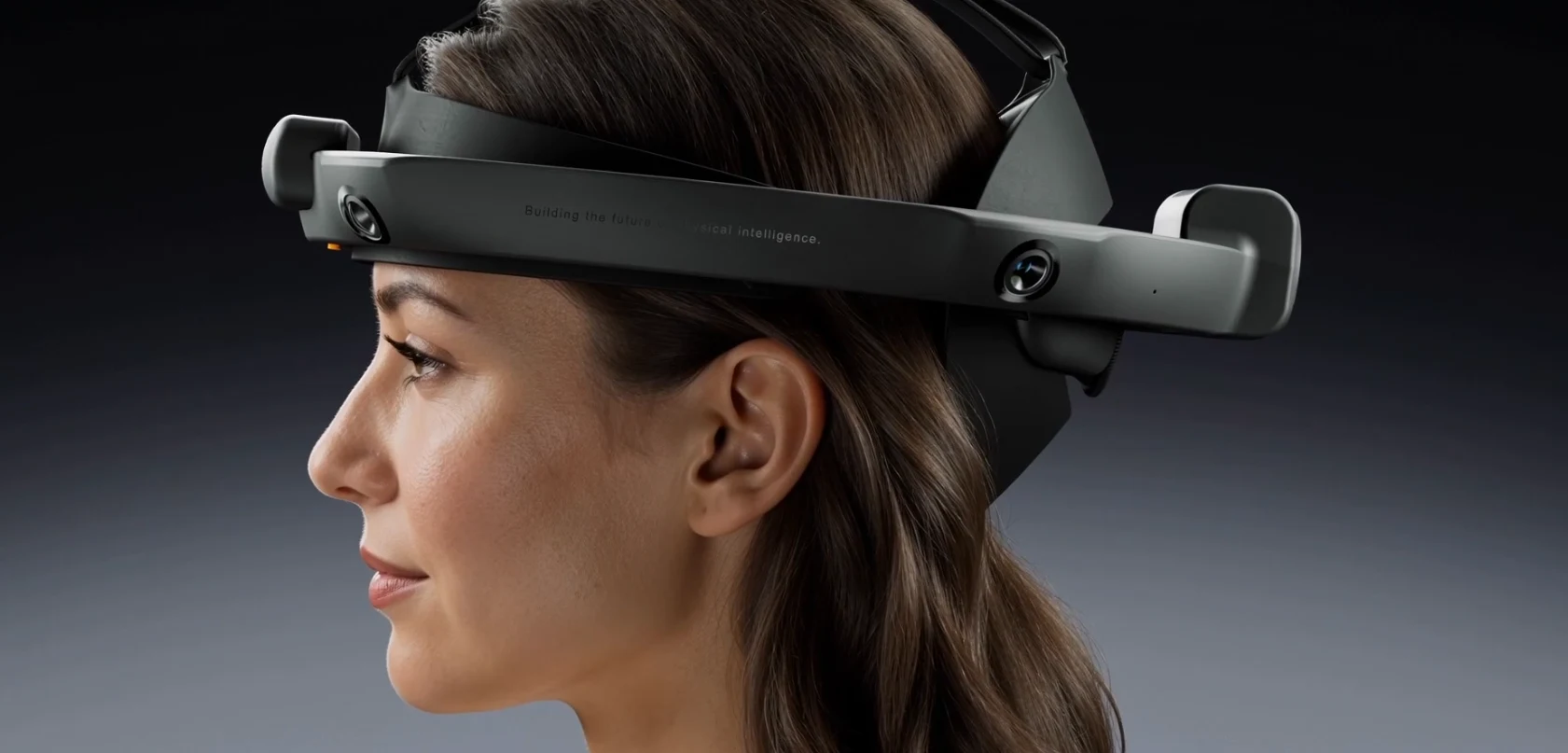
Ropedia’s latest step toward that vision is HOMIE Gen2, launched in August 2026 as a wearable system designed to capture human activity from a first-person perspective. The head-mounted device provides 360-degree visual coverage and records 1080p video at 30 frames per second, alongside four-channel spatial audio. Weighing around 380 grams, HOMIE Gen2 is designed to be used hands-free in real environments, allowing data to be captured while people perform everyday activities rather than requiring them to recreate those activities inside a laboratory. The system is particularly interesting because physical AI needs more than conventional video.
Ropedia’s Human Experience Engine is designed to synchronize and structure more than 10 types of information, including video, audio, depth, movement, body pose, and spatial signals. The company says testing has demonstrated accuracy of up to 96% in capturing and interpreting human activity. HOMIE Gen2 is also designed to support synchronized capture across multiple devices, potentially allowing the same environment to be recorded from different people and viewpoints. The launch builds on Ropedia’s growing dataset infrastructure.
The company says its Xperience-10M dataset contains more than 10 million interaction episodes drawn from 10,000 hours of first-person recordings. That gives the company a potential foundation for creating datasets that capture not only what humans do, but how they interact with objects and environments while completing tasks. The importance of this approach is becoming clearer as robotics developers look for ways to train models that can operate outside controlled environments. A robot that has only learned from demonstrations may struggle when the lighting changes, an object is placed somewhere unexpected, or a human behaves differently.
Diverse first-person experience can expose AI systems to precisely those variations. Ropedia is betting that scaling this type of data collection will become a critical part of building capable physical AI.
Ropedia Raises $30M to Build the Data Layer for Physical AI
Ropedia’s ambition has attracted significant funding as investors increasingly view data as one of the most important bottlenecks in robotics. The company has raised a combined $30 million, including an earlier $8 million round and a subsequent $22 million pre-Series A financing. The latest round brings Ropedia’s total funding to $30 million and is being used to scale its data infrastructure, expand its collection capabilities, and support the development of systems such as HOMIE. The funding comes at an important moment for physical AI.
Robotics companies are developing increasingly sophisticated hardware and foundation models, but those systems still require enormous amounts of real-world information to learn how to perform tasks reliably. Unlike digital AI, robotics data cannot simply be scraped from the internet. Someone or something needs to physically perform the task, record the interaction, capture the surrounding environment, and convert the resulting information into a format that AI models can learn from. Ropedia is attempting to build that infrastructure at scale. Its founders believe that human data can help bridge the gap created by the relatively small number of robots currently operating in the real world.
As CEO Zhaoxi Chen has argued, autonomous vehicles benefited from millions of vehicles generating real-world data, while physical AI does not yet have an equivalent scale of robot deployment. Human experience could provide a way to bridge that gap while robots are still becoming widespread. The $30 million raised gives Ropedia the opportunity to expand both sides of this equation: the hardware used to capture human experience and the datasets and intelligence infrastructure needed to turn those recordings into useful training material.
If humanoid and general-purpose robots eventually become as common as AI software is today, the demand for diverse physical-world training data could become enormous. Ropedia is positioning itself for that future by attempting to make human experience a scalable resource for the robot age.