


Granola Is Building the Memory Layer for the AI Workplace
Granola: The AI Notepad for People in Back-to-Back Meetings
Meetings are where companies make decisions, share context, assign work, and exchange information, yet the knowledge created inside them is often difficult to preserve. Traditional meeting transcription tools attempt to solve this problem by recording and transcribing conversations, but Granola takes a different approach. The company describes its product as “the AI notepad for people in back-to-back meetings,” positioning it as a workspace that combines a user’s own notes with AI-generated meeting context. Instead of asking participants to manage a separate recording or transcription workflow, Granola is designed to work alongside the way people already take notes.
The application captures the conversation and combines it with the user’s own written notes, producing a richer representation of what happened during the meeting. This can make it easier to retrieve decisions, action items, important details, and context later. The bigger idea is that meetings should not simply produce a transcript that someone has to read. They should create structured knowledge that can be reused across the organization. That becomes increasingly important as companies adopt AI assistants and agents. An AI system can only provide useful answers about a business if it has access to the context behind decisions, conversations, customer interactions, and internal discussions.
Granola is therefore moving toward becoming a memory layer for the workplace, where conversations can become persistent organizational knowledge rather than disappearing when a meeting ends. For employees who spend much of their day moving from one meeting to another, that could mean less time manually documenting conversations and less risk of losing important information.
Granola for Apple Watch
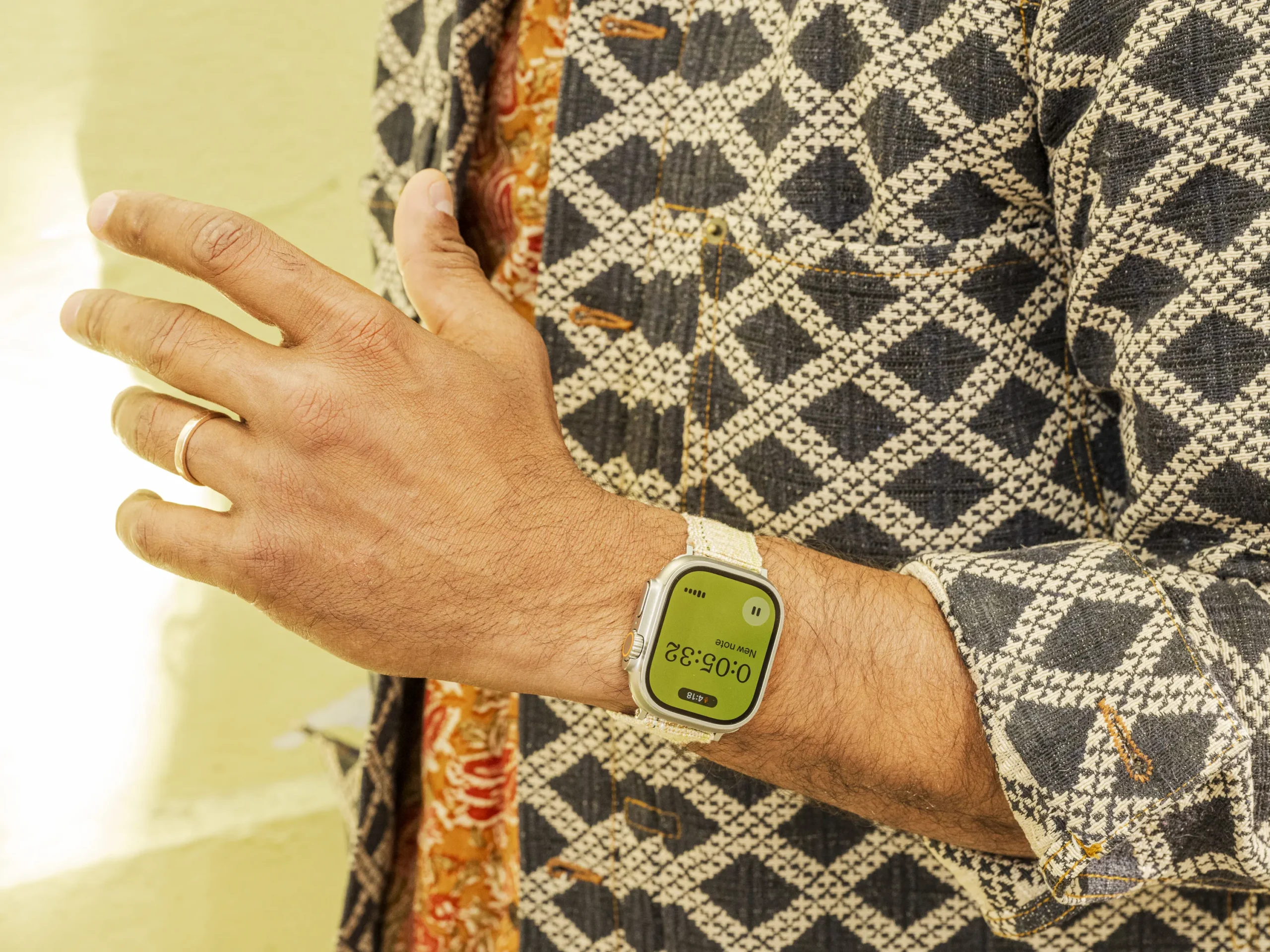
Granola’s expansion to the Apple Watch adds another dimension to its vision of capturing workplace context without requiring users to constantly interact with a computer. A smartwatch is already designed to remain with the user throughout the day, making it a natural interface for lightweight note-taking and meeting-related interactions. Bringing Granola to the Apple Watch reflects the company’s broader effort to make capturing information more ambient and less disruptive.
Instead of opening a laptop or phone to write something down, users can potentially use a device already on their wrist to capture or interact with important information. This matters because the most useful workplace knowledge is not always generated during formal video conferences. Conversations can happen while walking between meetings, during in-person discussions, or in situations where pulling out a laptop is inconvenient. As AI becomes increasingly capable of processing multimodal information, the devices used to capture context could become just as important as the AI models interpreting it.
Granola’s move toward wearable computing suggests a future where workplace memory is less dependent on users remembering to document everything themselves. The challenge, however, is balancing convenience with privacy and consent. Recording conversations, particularly in workplaces, requires clear policies and appropriate permissions. Granola’s success will therefore depend not only on the quality of its AI capabilities but also on whether users and organizations trust it with sensitive conversations. If it can establish that trust, wearable access could make the company’s broader vision of continuous workplace memory significantly more practical.
Granola vs Otter vs Fireflies vs Fathom
Granola operates in an increasingly crowded meeting-intelligence market alongside products such as Otter.ai, Fireflies.ai, and Fathom, but the distinction lies in how each product approaches the meeting experience. Otter and Fireflies have built strong positions around automated meeting transcription, searchable conversations, summaries, and integrations, while Fathom has focused heavily on AI meeting notes, summaries, and sales-oriented workflows.
Granola’s positioning is somewhat different because it emphasizes the AI notepad rather than presenting itself simply as another meeting recorder. The user’s own notes remain part of the experience, while AI adds context from the conversation around those notes. This creates a more human-in-the-loop approach in which the user can guide what matters while the AI handles the heavy lifting of understanding and organizing the discussion. The distinction could become increasingly important as meeting transcription becomes commoditized.
Simply converting speech into text is becoming easier as speech-recognition models improve, meaning the competitive advantage may increasingly shift toward what happens after the transcript is created. Can an AI system understand which decisions matter? Can it connect a discussion to previous meetings? Can it surface the relevant context when someone asks a question weeks later? Can it turn conversations into useful organizational memory? Granola’s opportunity is to answer those questions rather than compete purely on transcription accuracy. That puts it in a broader race to become part of the information infrastructure of the AI workplace.
If companies increasingly rely on AI agents to search internal knowledge, prepare employees, follow up on decisions, and automate workflows, the systems that capture conversational context could become increasingly valuable. Granola’s challenge is to ensure that its memory layer is accurate, useful, secure, and deeply integrated into the way businesses work. If it succeeds, the future of meeting software may be less about taking notes and more about making sure companies never lose the knowledge created through conversation.